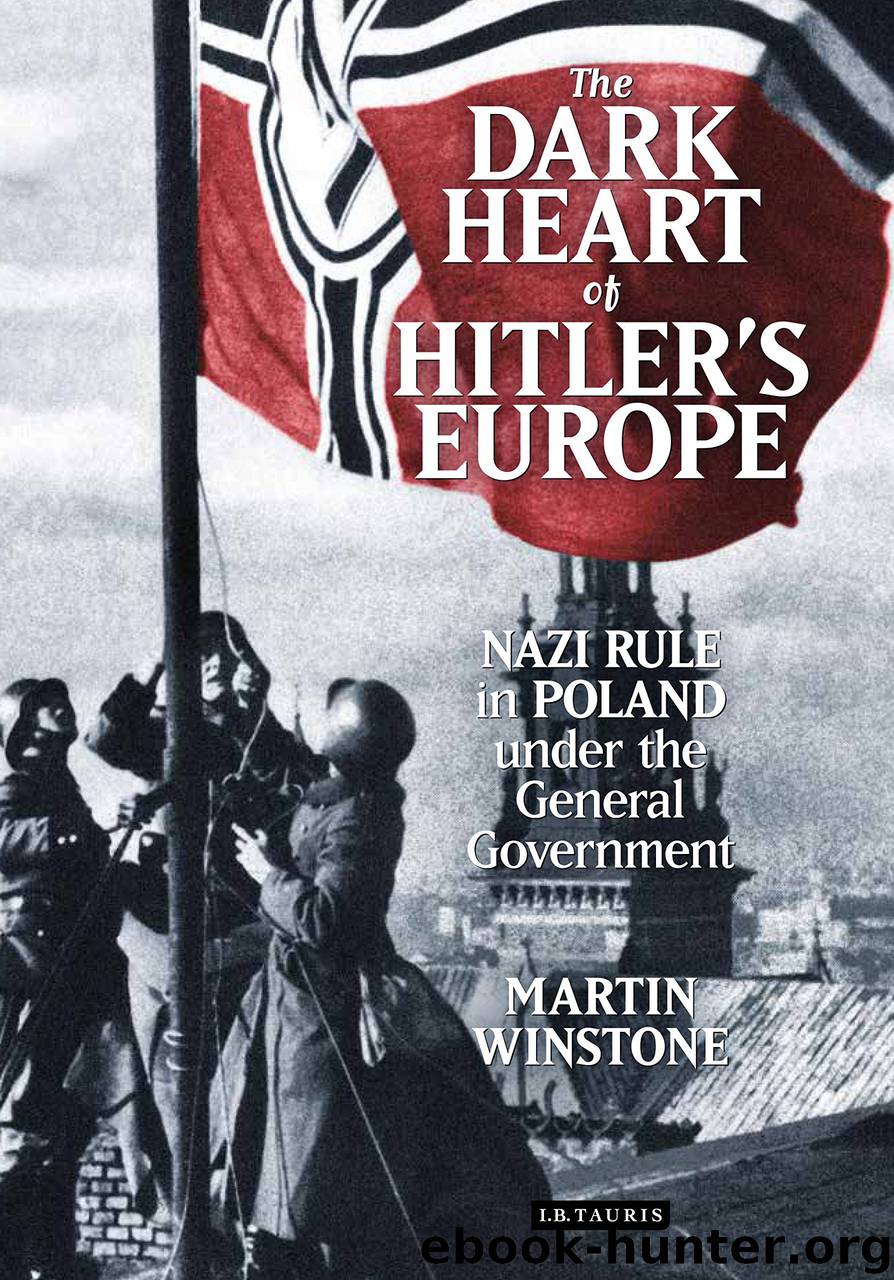
Dark Heart of Hitler's Europe: Nazi Rule in Poland under the General Government by Martin Winstone
Author:Martin Winstone [Winstone, Martin]
Language: eng
Format: epub
ISBN: 9780857735003
Publisher: I.B.Tauris
Published: 2015-10-04T16:00:00+00:00
7
‘The crying of the children’
Ethnic cleansing
ALL THAT IS KNOWN OF CZESłAWA KWOKA’S LIFE BEFORE THE WAR IS that she was born on 15 August 1928 and that her mother’s name was Katarzyna.1 The family toiled as presumably poor farmers in the hamlet of Wólka Złojecka until early December 1942 when they, and the village’s other Polish inhabitants, were forcibly expelled from their homes and sent to a transit camp in nearby Zamość. Czesława and Katarzyna’s stay in the camp was a short one, as on 10 December they were amongst more than 600 peasants placed on a transport which arrived in Auschwitz on the evening of 12 December. The prisoners were held overnight before being registered the next morning.2
Unlike most Jews, the majority of whom were sent straight to their deaths in Birkenau, new Polish inmates were given prisoner numbers (26946 for Katarzyna, 26947 for Czesława) and photographed. The pictures of the Kwokas, and thousands of others, were taken by Wilhelm Brasse, a Polish political prisoner from Silesia who had been sent to Auschwitz in August 1940. Brasse had trained as a portrait photographer before the war, prompting the camp administration to assign him to the team of inmates who photographed new arrivals. During the evacuation of the camp, the Nazis ordered the destruction of the portraits but Brasse and his colleagues were able to hide several thousand negatives, images which now constitute one of the most powerful exhibits in the Auschwitz museum. Brasse recalled Czesława’s case in the 2005 documentary film Portrecista (The Portraitist) and in a subsequent interview with a British newspaper. She ‘was so young and so terrified. The girl didn’t understand why she was there and she couldn’t understand what was being said to her.’ A female Kapo (Kapos were privileged prisoners who oversaw others) ‘took a stick and beat her about the face. This German woman was just taking out her anger on the girl. Such a beautiful young girl, so innocent. She cried but she could do nothing.’3 The triptych of photos of Czesława, showing a frightened teenager with a bloodied lower lip, is perhaps the most haunting of all of Brasse’s images.
Katarzyna Kwoka died in Auschwitz on 18 February 1943, just two months after arriving in the camp. Czesława died less than a month later on 12 March, on the same day that two Polish inmates from the very first transport (from Tarnów in 1940) – Jan Sarapata and Aleksander Martyniec – escaped.4 The cause of Czesława’s death is unknown although it is likely that she either succumbed to disease or was murdered with an injection of the poison phenol. She was 14 years old.
The train of events which led to the death of Czesława Kwoka, and thousands of others, was closely connected with Aktion Reinhard. Although the Nazis never developed plans for the systematic killing of Poles, the Zamość Aktion evolved in parallel to the murder of the Jews of the General Government and was perpetrated by the same individuals and agencies at almost the same time.
Download
This site does not store any files on its server. We only index and link to content provided by other sites. Please contact the content providers to delete copyright contents if any and email us, we'll remove relevant links or contents immediately.
| Anthropology | Archaeology |
| Philosophy | Politics & Government |
| Social Sciences | Sociology |
| Women's Studies |
The Secret History by Donna Tartt(19097)
The Social Justice Warrior Handbook by Lisa De Pasquale(12192)
Thirteen Reasons Why by Jay Asher(8915)
This Is How You Lose Her by Junot Diaz(6890)
Weapons of Math Destruction by Cathy O'Neil(6282)
Zero to One by Peter Thiel(5805)
Beartown by Fredrik Backman(5761)
The Myth of the Strong Leader by Archie Brown(5511)
The Fire Next Time by James Baldwin(5450)
How Democracies Die by Steven Levitsky & Daniel Ziblatt(5221)
Promise Me, Dad by Joe Biden(5155)
Stone's Rules by Roger Stone(5089)
A Higher Loyalty: Truth, Lies, and Leadership by James Comey(4965)
100 Deadly Skills by Clint Emerson(4929)
Rise and Kill First by Ronen Bergman(4792)
Secrecy World by Jake Bernstein(4755)
The David Icke Guide to the Global Conspiracy (and how to end it) by David Icke(4721)
The Farm by Tom Rob Smith(4516)
The Doomsday Machine by Daniel Ellsberg(4491)
